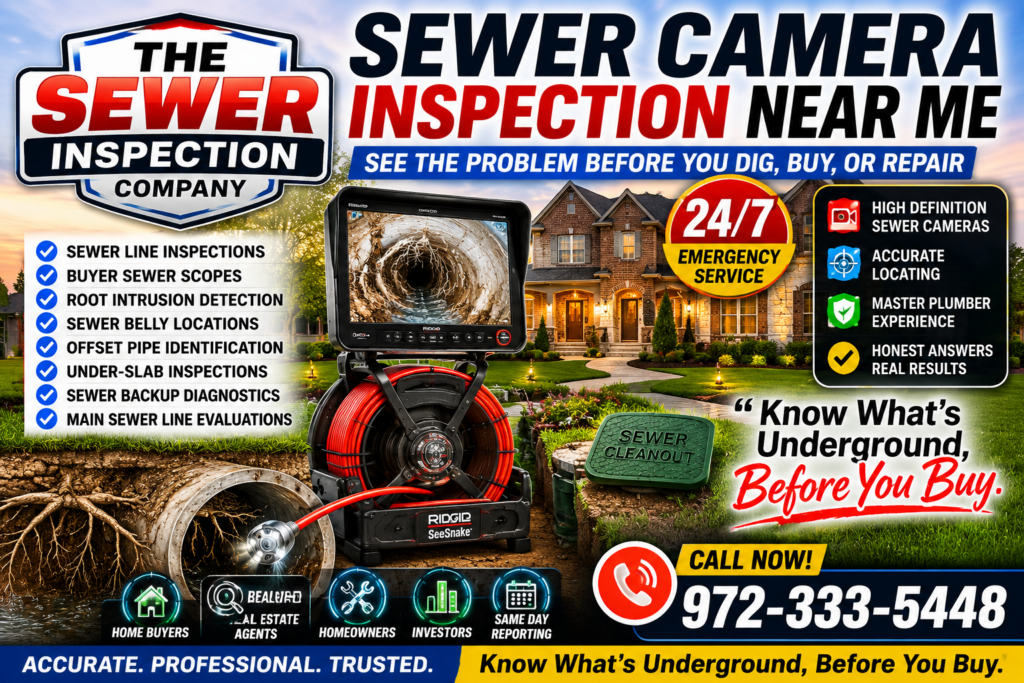
Sewer Camera Inspection Near Me: See the Problem Before You Dig, Buy, or Repair
Written by Steven Shipler, Texas Licensed Master Plumber, Responsible Master Plumber (RMP), MBA, and host of The 4 Guys Education on YouTube.
If you are searching for a sewer camera inspection near me, you probably need real answers about an underground sewer line. Maybe you are buying a home, dealing with recurring backups, seeing an exterior cleanout overflow, smelling sewer gas, or trying to decide whether a sewer repair estimate is actually necessary.
The Sewer Inspection Company provides sewer camera inspections, sewer line diagnostics, drain evaluations, under-slab sewer inspections, buyer sewer scopes, root intrusion inspections, sewer belly evaluations, offset pipe detection, and emergency sewer response throughout Plano, Frisco, Allen, McKinney, Richardson, North Dallas, Carrollton, Addison, Las Colinas, Irving, Coppell, and surrounding Dallas-Fort Worth areas.
The biggest problem with sewer lines is simple: they are underground. A house can look clean, the toilets can flush, and the seller can say everything works — but none of that proves the sewer line is in good condition.
Need a Sewer Camera Inspection Near You?
“`Schedule a sewer camera inspection before you buy, dig, approve a repair, or keep paying for repeated drain cleaning.
Call Now: 972-333-5448Know What’s Underground, Before You Buy. Emergency sewer help available 24/7.
“`What Is a Sewer Camera Inspection?
A sewer camera inspection is a video inspection of the underground sewer line. A specialized sewer camera is inserted through an approved access point such as a cleanout, roof vent, pulled toilet opening, or other accessible sewer entry point when available.
The camera travels through the pipe and shows the inside condition of the sewer line in real time.
A sewer camera inspection may show:
- Tree root intrusion
- Standing water
- Sewer line bellies
- Offset joints
- Pipe separations
- Broken pipe sections
- Collapsed sewer pipe
- Cast iron deterioration
- Clay pipe separation
- PVC settlement
- Grease buildup
- Sludge buildup
- Foreign objects
- Poor slope
- Previous repairs
- Possible city tap problems
The goal is not to scare the homeowner.
The goal is to show what is actually happening underground.
Why Homeowners Search “Sewer Camera Inspection Near Me”
Most people do not search for a sewer camera inspection unless something has raised a concern.
Common reasons include:
- Buying a home
- Selling a home
- Recurring drain backups
- Main sewer line clog
- Multiple drains backing up
- Exterior cleanout overflowing
- Sewer smell inside the home
- Toilets bubbling
- Slow drains throughout the house
- Foundation work was completed
- Mature trees are near the sewer path
- Old cast iron, clay, or Orangeburg pipe is suspected
- A plumber recommended sewer replacement
- A buyer wants proof before closing
- An insurance, realtor, or investor decision needs documentation
A camera inspection helps replace guesswork with video evidence.
Sewer Camera Inspection Before Buying a Home
A sewer camera inspection before buying a home is one of the smartest inspections a buyer can order.
A general home inspection usually does not prove the underground sewer line is in good condition. The toilets may flush during the showing. The sinks may drain during the inspection. The yard may look perfect. But underground sewer damage can still be hidden below the slab, yard, driveway, sidewalk, landscaping, or mature trees.
A buyer sewer scope can reveal expensive issues before closing, including:
- Roots in the line
- Sewer bellies holding water
- Collapsed sections
- Pipe separation near the foundation
- Offset joints caused by soil movement
- Cast iron deterioration under the slab
- Clay pipe failure
- Previous repairs that were not properly verified
- Improper slope
- Major defects near the city tap
The cheapest time to discover a sewer problem is before you buy the property, not after closing.
Recurring Drain Backups Need a Sewer Camera Inspection
Drain cleaning can open a clogged line, but it does not always explain why the line clogged.
If the same line keeps backing up, something may be wrong inside the pipe.
Repeated clogs may be caused by:
- Roots entering pipe joints
- Pipe bellies holding water and debris
- Offset fittings
- Broken pipe
- Cast iron scaling
- Clay pipe separation
- Grease buildup
- Foreign objects
- Poor slope
- Collapsed sewer pipe
If a drain keeps backing up after cleaning, the next step should usually be a sewer camera inspection.
Main Sewer Line Inspection
The main sewer line carries wastewater from the home to the city sewer or private disposal system.
When the main line has a problem, symptoms may show up throughout the home.
Main sewer line warning signs include:
- Multiple drains backing up at once
- Toilets gurgling
- Bathtubs or showers backing up with dirty water
- Floor drains overflowing
- Laundry drain backup
- Outside cleanout overflowing
- Sewer smell inside or outside the home
- Drain cleaning only works temporarily
These symptoms should not be ignored. A sewer camera inspection can help determine whether the issue is a blockage, pipe defect, root problem, low spot, or structural failure.
What a Sewer Camera Inspection Cannot Do
A sewer camera is powerful, but it is not magic.
A sewer camera can show the visible interior condition of the pipe. It can identify many defects, confirm restrictions, and help locate problem areas.
But a sewer camera does not see through dirt, concrete, walls, or the outside of the pipe.
A sewer camera inspection may need to be combined with:
- Locating equipment
- Depth readings
- Cleanout location verification
- Drain cleaning before inspection
- Hydro jetting evaluation
- Smoke testing
- Pressure testing
- Excavation verification in severe cases
The best sewer inspection combines camera evidence with plumbing judgment.
Camera Inspection vs. Drain Cleaning
Drain cleaning and sewer camera inspection are related, but they are not the same service.
| Service | What It Does | Best Use | Main Limitation |
|---|---|---|---|
| Drain Cleaning | Clears or opens the line | Active clog or slow drain | May not show why the clog happened |
| Sewer Camera Inspection | Shows visible pipe condition | Buying a home, recurring clogs, repair decisions | May need cleaning first if line is blocked |
| Line Locating | Marks approximate path and depth | Repair planning and excavation decisions | Requires signal, access, and site conditions |
Common Sewer Defects Found During Camera Inspections
The Sewer Inspection Company looks for conditions that affect flow, pipe structure, and repair risk.
Roots
Tree roots often enter sewer lines through small openings at joints, cracks, or separations. Once inside, roots can catch paper, grease, and debris until the line backs up.
Sewer Bellies
A sewer belly is a low section of pipe that holds standing water. Bellies can collect solids, grease, and debris, creating recurring backup problems.
Offsets
An offset happens when two pipe sections no longer line up properly. Offsets can be caused by soil movement, poor installation, tree roots, or foundation movement.
Cast Iron Deterioration
Older cast iron sewer lines can scale, corrode, crack, and lose the bottom channel. The line may still drain, but the interior may be rough, restricted, and structurally weak.
Clay Pipe Separation
Older clay sewer lines may separate at joints, allowing roots and soil to enter. This can lead to recurring clogs and structural failure.
Standing Water
Standing water inside the sewer line may indicate poor slope, a belly, blockage, obstruction, or a damaged pipe section.
Under-Slab Sewer Camera Inspection
Under-slab sewer problems are serious because the pipe is below the concrete foundation.
A camera inspection can help identify whether the under-slab drain system has:
- Cast iron deterioration
- Separated fittings
- Standing water
- Improper slope
- Broken sections
- Offsets
- Root intrusion near the foundation
- Possible tunneling or reroute concerns
When under-slab damage is found, the next step may be locating the defect, estimating repair access, evaluating reroute options, or getting additional testing before approving major work.
Cleanouts and Sewer Camera Access
The best sewer camera access is usually an exterior cleanout. A cleanout allows a technician to access the sewer line without removing a toilet.
Common access points may include:
- Two-way exterior cleanout
- Single-direction cleanout
- Yard cleanout
- Wall cleanout
- Roof vent when appropriate and safe
- Pulled toilet opening when no cleanout is available
If there is no accessible cleanout, a toilet may need to be removed and reset so the sewer camera can access the line.
If a home does not have a usable cleanout, sewer inspection may still be possible, but access may require removing a toilet or using another approved entry point.
What Happens During a Sewer Camera Inspection?
A good sewer camera inspection should be organized and easy for the customer to understand.
Step 1: Identify the access point
The technician looks for an exterior cleanout, accessible drain opening, roof vent, or toilet access point if a toilet must be removed.
Step 2: Camera inspect the sewer line
The camera is pushed through the sewer line while the technician watches for standing water, roots, bellies, offsets, breaks, pipe separations, and pipe material changes.
Step 3: Record the findings
The inspection should document the findings clearly. The Sewer Inspection Company uses video-based reporting so homeowners can review the condition of the line.
Step 4: Locate serious defects when needed
If a major defect is found, locating equipment may help identify the approximate surface location and depth for repair planning.
Step 5: Explain the next step
The next step may be no repair, drain cleaning, hydro jetting, pipe descaling, spot repair, partial sewer replacement, trenchless repair, under-slab repair, or reroute evaluation.
When a Sewer Camera Inspection Becomes Urgent
Some inspections are scheduled as part of a real estate purchase.
Other inspections are urgent because the sewer system is failing.
Call right away if you have:
- Sewage backing up into the home
- Multiple drains backing up at once
- Exterior cleanout overflowing
- Main line that will not stay open
- Sewer smell inside the home
- Water or sewage near electrical equipment
- A failed drain line at a rental or short-term rental property
- A buyer option period deadline
- A repair estimate that needs verification
The Sewer Inspection Company handles emergency sewer and drain issues 24/7.
Emergency Sewer Camera Inspection Help
If sewage is backing up, your cleanout is overflowing, or the main line will not stay open, do not keep running water.
Call The Sewer Inspection Company for sewer inspection, drain diagnostics, and emergency sewer help.
24/7 emergency service: 972-333-5448
Should You Get a Sewer Camera Inspection Before Approving Sewer Repair?
Yes.
If someone recommends a sewer repair, replacement, tunneling, pipe bursting, trenchless repair, or reroute, the homeowner should understand why.
Before approving major sewer work, ask:
- Can I see the sewer camera video?
- Where is the defect?
- How deep is the line?
- What pipe material is involved?
- Is the defect under the slab, yard, driveway, sidewalk, or street?
- Is this an isolated problem or a system-wide issue?
- Is drain cleaning enough?
- Is hydro jetting appropriate?
- Is a spot repair enough?
- Is replacement or rerouting really necessary?
- Does the repair require a permit?
- Will the repair be inspected?
- Will the line be tested before covering?
A major sewer repair should be based on evidence, not pressure.
How The Sewer Inspection Company Helps
The Sewer Inspection Company is built around one idea:
Know what is underground before you buy, dig, repair, or panic.
Our sewer inspection services include:
- Sewer camera inspections
- Buyer sewer scope inspections
- Drain diagnostics
- Main sewer line inspections
- Under-slab sewer evaluations
- Cast iron sewer evaluations
- Root intrusion inspections
- Sewer belly evaluations
- Offset pipe identification
- Sewer locating when needed
- Emergency sewer response
- Master Plumber review
We provide sewer inspection help throughout Plano, Allen, McKinney, Frisco, Richardson, North Dallas, Carrollton, Addison, Las Colinas, Irving, Coppell, and nearby Dallas-Fort Worth areas.
Schedule a Sewer Camera Inspection Near You
“`If you are buying a home, dealing with recurring backups, or reviewing a sewer repair estimate, do not guess.
Schedule a sewer camera inspection and get video evidence before making a major decision.
Call Now: 972-333-5448Know What’s Underground, Before You Buy. Emergency sewer help available 24/7.
“`Final Answer: A Sewer Camera Inspection Near You Can Save Thousands
A sewer camera inspection is one of the best ways to understand the true condition of an underground sewer line.
It can reveal roots, bellies, standing water, offsets, broken pipe, cast iron deterioration, clay pipe separation, PVC settlement, previous repairs, and hidden under-slab problems before they become larger repair decisions.
If you are buying a home, dealing with recurring drain backups, or reviewing a sewer repair estimate, schedule a sewer camera inspection before approving major work.
Call The Sewer Inspection Company today at 972-333-5448.
Helpful Internal Links
- Sewer Inspection Plano TX
- Drain Cleaning Plano TX
- Hydro Jetting Plano TX
- Sewer Line Repair Plano TX
- Trenchless Sewer Repair Plano TX
- Emergency Plumber Plano TX
- Contact Us
- Reviews
FAQs
What is a sewer camera inspection?
A sewer camera inspection is a video inspection of the inside of an underground sewer line. It helps identify roots, bellies, standing water, offsets, broken pipe, cast iron deterioration, clay pipe separation, and other sewer line defects.
When should I schedule a sewer camera inspection?
Schedule a sewer camera inspection before buying a home, after recurring sewer backups, when multiple drains clog, when a cleanout overflows, when you smell sewer gas, or before approving major sewer repair work.
Can a sewer camera inspection find roots?
Yes. A sewer camera inspection can often show root intrusion inside the sewer line, especially where roots enter through cracks, joints, offsets, separations, or damaged pipe sections.
Can a sewer camera inspection find a sewer belly?
Yes. A camera inspection can show standing water inside the line, which may indicate a sewer belly, poor slope, pipe settlement, or obstruction.
Do I need a cleanout for a sewer camera inspection?
A cleanout is the best access point when available. If there is no usable cleanout, the inspection may require another approved access point, such as a pulled toilet opening or other accessible drain entry point.
Do you provide emergency sewer inspections?
Yes. The Sewer Inspection Company handles emergency sewer and drain issues 24/7. Call 972-333-5448 for emergency sewer inspection or drain help.
10 IPC, UPC, and Related Plumbing Code Reference Links
These resources support the sewer inspection, sanitary drainage, cleanout, venting, trap, testing, and plumbing system topics discussed in this article. Always verify the code edition adopted by the local city before starting work.
“`| # | Code Source | Why It Matters | Link |
|---|---|---|---|
| 1 | 2024 IPC — Full Code | General reference for International Plumbing Code requirements. | 2024 IPC |
| 2 | 2024 IPC — Chapter 3 General Regulations | Supports testing, inspections, system protection, and general plumbing requirements. | IPC Chapter 3 |
| 3 | 2024 IPC — Chapter 4 Fixtures | Supports fixture, toilet, sink, tub, shower, and plumbing fixture topics. | IPC Chapter 4 |
| 4 | 2024 IPC — Chapter 6 Water Supply | Provides water system context related to plumbing system performance and testing. | IPC Chapter 6 |
| 5 | 2024 IPC — Chapter 7 Sanitary Drainage | Primary sanitary drainage, building sewer, drainage pipe, cleanout, and sewer system reference. | IPC Chapter 7 |
| 6 | 2024 IPC — Chapter 8 Indirect and Special Wastes | Supports special waste and indirect drainage conditions that can affect diagnostics. | IPC Chapter 8 |
| 7 | 2024 IPC — Chapter 9 Vents | Supports vent system discussion related to drainage performance and fixture behavior. | IPC Chapter 9 |
| 8 | 2024 IPC — Chapter 10 Traps, Interceptors and Separators | Supports trap, grease, sewer gas, interceptor, and drainage protection topics. | IPC Chapter 10 |
| 9 | 2024 IPC — Chapter 11 Storm Drainage | Provides drainage context where exterior water issues may be confused with sewer issues. | IPC Chapter 11 |
| 10 | 2024 Uniform Plumbing Code | UPC reference for sanitary drainage, fixtures, cleanouts, vents, testing, and plumbing system standards. | 2024 UPC |
3 Local City References
These local resources support permit, inspection, adopted-code, and plumbing inspection awareness for North Dallas sewer inspection and repair decisions.
“`- City of Plano — Code Information: https://www.plano.gov/610/Code-Information
- City of Frisco — Adopted Codes: https://www.friscotexas.gov/397/Adopted-Codes
- City of Dallas — Plumbing and Mechanical Inspections: https://dallascityhall.com/departments/sustainabledevelopment/buildinginspection/Pages/plumbing_mechanical.aspx
3 Tool and Equipment References
These tool references support the sewer camera inspection, locating, and line tracing equipment discussed in this article.
“`- RIDGID SeeSnake Sewer Cameras and Reels: https://www.ridgid.com/us/en/reels-and-cameras
- RIDGID SeekTech SR-20 Locator: https://www.ridgid.com/us/en/seektech-sr20-locator
- RIDGID SeekTech ST-305 Line Transmitter: https://www.ridgid.com/us/en/seektech-st305-line-transmitter
Additional Sewer Inspection, Licensing, and Structured Data References
“`- InterNACHI — Sewer Scope Standard of Practice
- InterNACHI — Sewer Scope Inspection Information
- NASSCO — PACP/LACP/MACP Pipeline Assessment Training
- EPA — Sanitary Sewer Overflows
- EPA — Sanitary Sewer Overflow FAQs
- Texas State Board of Plumbing Examiners — Responsible Master Plumber
- Texas State Board of Plumbing Examiners — Master Plumber
- Schema.org — Plumber Structured Data
- Google Search Central — Local Business Structured Data