
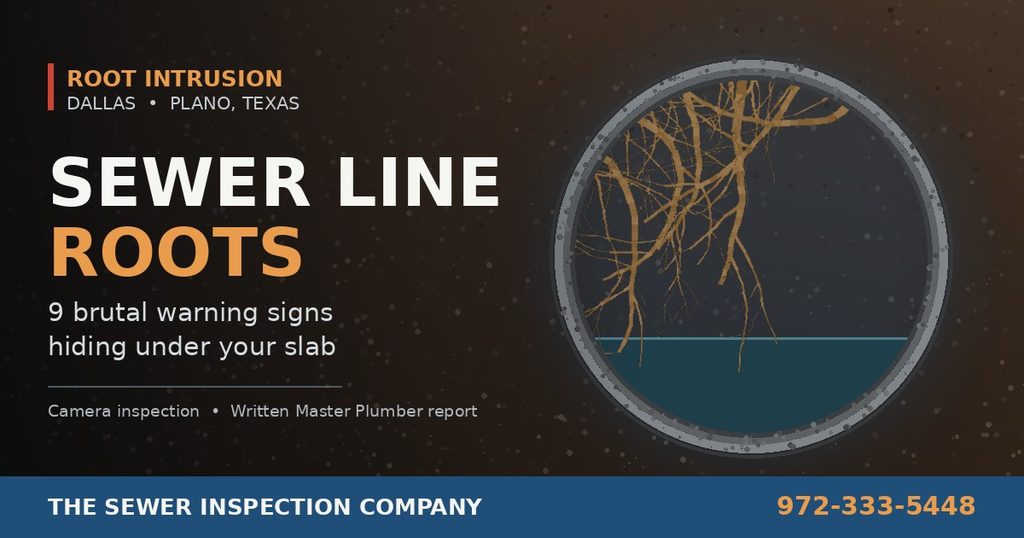
9 Brutal Sewer Line Root Invasions Destroying Dallas and Plano TX Homes
Prepared by Steven Shipler, Master Plumber, Responsible Master Plumber (RMP), MBA, and Master Plumber in Texas, Colorado, and Montana.
Tree roots are the most relentless enemy a residential sewer system faces in North Texas. They never rest, they never stop searching for moisture, and they do not care how old the pipe is or how much the repair may cost.
Homeowners throughout Dallas and Plano TX are frequently stunned to learn that a mature shade tree in the front yard has been slowly strangling the underground sewer line for years. In most cases, there is no warning at the surface until wastewater begins backing up into a tub, a floor drain, or a downstairs bathroom.
Why Tree Roots Attack Sewer Lines in North Texas
Roots do not attack sewer pipes out of aggression. They follow moisture, oxygen, and nutrients, and a slightly leaking sewer line delivers all three in abundance.
North Texas creates nearly ideal conditions for this problem. Expansive clay soil expands during wet seasons and contracts hard during summer drought, and that seasonal movement may pull pipe joints apart, crack older fittings, and open hairline gaps in aging sewer systems.
Once a gap exists, warm and humid vapor escapes into surrounding soil. Roots detect that vapor trail and grow directly toward it. A root the width of a human hair may enter through a joint, then thicken season after season until it fills the pipe entirely.
Many Dallas and Plano properties are also served by older clay tile, Orangeburg, or cast iron sewer systems installed decades ago. Clay tile joints are especially vulnerable because the original joint material may deteriorate long before the pipe body fails.
Warning Signs of Root Intrusion Homeowners Frequently Ignore
Root damage often produces symptoms that appear minor at first, which is exactly why the problem is allowed to progress:
- Recurring drain backups in the lowest fixture of the home
- Gurgling toilets when a washing machine drains
- Slow drains that return weeks after being cleared
- Sewer odors in the yard or near a cleanout
- One unusually green or fast-growing patch of lawn
- Standing wastewater inside the sewer line
- Soft or sunken soil above the sewer route
- Drain flies near floor drains
- Wet soil beneath the slab foundation
- Repeated service calls that never resolve the underlying cause
A sewer line may be forty percent blocked by roots and still drain well enough that a homeowner never suspects a problem until the line fails completely.
Underground Sewer Problems Near Coit Road in Plano TX
This sewer inspection near Coit Road in Plano TX revealed hidden underground plumbing stress, standing wastewater, and early sewer deterioration beneath the property.
Approximate GPS location: 33.0245° N, -96.7695° W
The camera inspection near Coit Road identified fine hair roots entering through a joint approximately thirty-one feet from the cleanout, along with scale buildup and a shallow section of standing water indicating a belly in the line.
The homeowner had assumed the recurring backups were caused by household paper products. The inspection footage told a very different story.
Underground Sewer Problems Near Skillman Street in Dallas TX
This sewer inspection near Skillman Street in Dallas TX revealed hidden underground plumbing stress, standing wastewater, and early sewer deterioration beneath the property.
Approximate GPS location: 32.8747° N, -96.7381° W
In this older East Dallas neighborhood, mature trees line both sides of the street and the original clay tile sewer system remains in service beneath several properties.
The inspection revealed a dense root mass at a joint, an offset section where the pipe had shifted, and evidence of a previous root cutting attempt that had temporarily restored flow without addressing the opening in the pipe.
The 9 Brutal Ways Roots Destroy a Sewer System
Root intrusion rarely causes a single, isolated problem. It sets off a chain of underground failures:
- Root webbing catches solids. Fine roots form a net inside the pipe that traps paper, grease, and debris.
- Flow restriction increases. The trapped mass hardens and the usable pipe diameter shrinks.
- Standing wastewater develops. Water that cannot move begins corroding cast iron from the inside.
- Joints are forced open. As roots thicken, they may pry pipe sections apart from within.
- The pipe cracks. Radial pressure from a maturing root may fracture clay tile and older fittings.
- Soil washes into the line. Wastewater escapes through openings and surrounding soil enters the pipe.
- Voids form beneath the slab. Lost soil may create empty pockets under the foundation.
- Foundation movement may follow. Unsupported soil beneath a slab may contribute to settlement.
- The repair scope explodes. What began as a joint repair may become a full under-slab replacement.
Each stage costs meaningfully more than the one before it, which is why early sewer inspection in Dallas TX and documented camera evidence matter so much.
Many homeowners schedule a Sewer Inspection Plano TX service after recurring drain backups or foundation movement concerns.
Which Trees Cause the Most Sewer Damage in Dallas and Plano
Any tree may reach a sewer line, but some species are far more aggressive than others in North Texas soil:
- Willow
- Silver maple
- Cottonwood
- American elm
- Hackberry
- Sweetgum
- Bradford pear
- Live oak and red oak
- Ligustrum and other large ornamental shrubs
A useful rule is that a root system commonly extends at least as far as the tree is tall, and often considerably farther during drought. A tree standing forty feet from the house is not automatically a safe distance from the sewer line.
What a Sewer Camera Inspection May Reveal
A professional camera inspection documents the actual condition of the line rather than relying on assumptions. It may identify:
- Fine hair root intrusion at joints
- Mature root masses blocking flow
- Cracked or fractured clay tile
- Offset joints and separated fittings
- Standing wastewater and bellied sections
- Heavy cast iron scale and corrosion
- Grease accumulation
- Soil intrusion and voids
- Improper slope
- Previous failed repairs
Footage counters record the distance to each defect, which allows any future sewer repair in Dallas TX to be planned precisely instead of exploratory digging across a yard.
Root Cutting, Hydro Jetting, and Sewer Repair Compared
Mechanical root cutting with a cable machine removes the obstruction and restores flow quickly. It is often the correct emergency response, but the cut roots typically regrow, frequently within months.
Hydro jetting in Plano TX uses high-pressure water to scour the pipe wall, removing root hair, grease, sludge, and scale far more thoroughly than a cable alone. It restores capacity and produces a clean pipe for accurate camera evaluation.
Neither method repairs the opening that allowed roots inside. When drain cleaning in Dallas TX must be repeated on the same line, the underlying structural defect is usually the real issue.
Depending on pipe condition, options may include:
- Spot repair at a single failed joint
- Partial sewer replacement
- Trenchless sewer repair in Plano TX
- Pipe lining to seal joints against future intrusion
- Full under-slab sewer replacement
When escaping water has already saturated soil beneath the foundation, leak detection in Dallas TX and slab leak detection in Plano TX may be recommended alongside the sewer evaluation.
How Dallas and Plano Homeowners May Reduce Root Damage
- Schedule a camera inspection every two to three years on properties with mature trees
- Inspect before purchasing any home built before 1995
- Avoid planting aggressive species near the sewer route
- Locate and mark the sewer line before landscaping or foundation work
- Address slow drains immediately instead of waiting for a backup
- Keep a cleanout accessible and above grade
- Seal joints during repair rather than only clearing the blockage
- Document line condition in writing for insurance and resale purposes
10 Frequently Asked Questions About Sewer Line Roots in Dallas and Plano TX
1. How do roots actually get inside a sewer pipe?
Roots enter through existing openings such as loose joints, hairline cracks, or deteriorated fittings. They follow escaping moisture and vapor, then expand inside the pipe over multiple growing seasons.
2. Can roots break a sewer line that was not already damaged?
Roots generally exploit an existing weakness rather than penetrating sound pipe. However, once inside, root growth may widen that weakness until the pipe cracks or separates.
3. How do I know whether roots or grease are causing my backups?
Only a camera inspection can confirm the cause. Root intrusion, grease accumulation, scale, and bellied pipe may all produce nearly identical symptoms at the fixture.
4. Will cutting the roots solve the problem permanently?
Usually not. Cutting restores flow, but roots commonly regrow through the same opening. Lasting resolution generally requires sealing or replacing the damaged section.
5. Is hydro jetting safe for older cast iron and clay pipe?
Hydro jetting is frequently appropriate, but pipe condition should be evaluated by camera first. Severely deteriorated sections may require a different approach.
6. Can sewer root damage affect my foundation?
It may. Water escaping from a compromised sewer line can saturate or erode soil beneath the slab, and unsupported soil may contribute to foundation movement over time.
7. Do Plano and Dallas homes have different root problems?
The mechanism is the same, though many older East Dallas neighborhoods have clay tile systems and very mature trees, while numerous Plano homes from the 1970s through early 1990s rely on aging cast iron beneath the slab.
8. Should I get a sewer inspection before buying a home?
Yes. A standard home inspection does not include a sewer camera evaluation, and root damage is invisible from the surface. Inspecting before closing may prevent a significant post-purchase expense.
9. How long does a sewer camera inspection take?
Most residential inspections are completed within about an hour, depending on access, line length, and the amount of blockage present.
10. Do you provide emergency service for a root blockage?
Yes. Emergency plumbing in Dallas TX and emergency plumbing in Plano TX are available for active backups and sewer failures.
Schedule a Dallas or Plano TX Sewer Inspection Today
Find the roots before the roots find your foundation. Camera inspection with a written Master Plumber report.
Call Now: 972-333-5448Sewer inspections, drain cleaning, hydro jetting, leak detection, and emergency plumbing available throughout Dallas and Plano TX.
What Our Customers Say
Brad Miller — 5 Stars
“The Sewer Inspection Company did a thorough job inspecting the sewer line and explaining each step. They identified the problem area, showed me the findings, and provided a clear written Master Plumber report. Very professional from start to finish.”
Cameron Liingle — 5 Stars
“The technician arrived prepared, ran the sewer camera through the line, and took the time to explain what he was seeing. Communication was excellent, and I appreciated how carefully everything was documented.”
Troy Modie — 5 Stars
“I had no idea what was going on underground, but The Sewer Inspection Company methodically inspected the line and identified the likely problem area. The process was organized, professional, and saved us from guessing.”
Mark Ryan — 5 Stars
“Great sewer inspection service. They took the time to inspect the line properly instead of rushing to a conclusion. The findings were clearly explained, and the Master Plumber report made it easy to understand the next steps.”
Kymberly Larson — 5 Stars
“The Sewer Inspection Company was responsive, knowledgeable, and very detailed. They showed us what was happening inside the sewer line, explained the inspection results, and gave us confidence about what needed to be done next. Highly recommended.”
Helpful Internal Links
- Sewer Inspection Dallas TX
- Sewer Inspection Plano TX
- Drain Cleaning Dallas TX
- Drain Cleaning Plano TX
- Hydro Jetting Dallas TX
- Hydro Jetting Plano TX
- Sewer Line Repair Dallas TX
- Sewer Line Repair Plano TX
- Trenchless Sewer Repair Dallas TX
- Trenchless Sewer Repair Plano TX
- Slab Leak Detection Dallas TX
- Slab Leak Detection Plano TX
- Leak Detection Dallas TX
- Leak Detection Plano TX
- Emergency Plumber Dallas TX
- Emergency Plumber Plano TX
- Lone Star Leak Locators
Plumbing & Sewer Citation Resources
| Resource | Link |
|---|---|
| Texas State Board of Plumbing Examiners | Visit |
| InterNACHI Sewer Scope Information | Visit |
| EPA Water Information | Visit |
| Texas A&M Forest Service — Tree Care | Visit |
| Texas 811 Utility Locate | Visit |
| City of Dallas Water Utilities | Visit |
| City of Plano Utilities | Visit |
| International Plumbing Code | Visit |
| CDC Healthy Water | Visit |
| Schema.org Plumbing Data | Visit |