
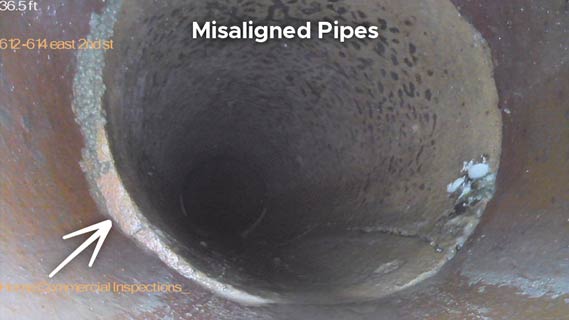
Practical answer: An observed defect is something the camera actually records, such as a visible offset, root entry, crack, deposit, or passage limit. A suspected cause is an interpretation, such as soil movement or installation error. A strong report separates those two so a DFW owner does not authorize a repair from an assumption.
Name the visible evidence first
The narrated video should show the approach, the feature, and the withdrawal. A still frame can distort depth or shape. Describe what appears on screen: a ledge at a joint, water entering, roots at an opening, missing pipe wall, or material blocking the lens. Avoid claiming what exists outside the pipe when the camera cannot see it.
Use measurement tools for location, not causation
The V-SCOPE footage counter estimates cable travel from the chosen access. A camera-head sonde and surface receiver can estimate position and depth. Those readings help relate a visible feature to the property, but they do not prove why the pipe moved, cracked, or filled with debris.
List plausible causes without choosing one prematurely
An offset may relate to movement, poor support, installation, or later disturbance. Water may enter through a joint, branch, or crack. Roots show an opening but do not reveal the full exterior path. The Certified Master Plumber Report can explain reasonable possibilities while clearly labeling what remains unverified.
Connect the finding to a defined next step
The next action should answer the unresolved question. A second access can show another side of an obstruction. Cleaning may improve visibility. A surface locate may mark an area. Excavation may expose the outside condition. Separate testing may evaluate leakage. More force on the camera is not a substitute for evidence.
Why this distinction matters in North Texas
Expansive soils and foundation work are common discussion points around Plano, Dallas, and Richardson, but a camera image alone cannot assign soil movement as the cause. A property-specific conclusion needs site history and appropriate evaluation. Accurate wording protects the buyer, owner, and contractor from treating a possibility as a fact.
What Steven Shipler’s report should preserve
The report should preserve access, direction, footage, visible condition, locate result, visibility limits, and recommended follow-up. That creates a record another professional can use without inventing details that the V-SCOPE did not show.
Local plumbing-code references
A sewer camera documents visible conditions; it does not certify code compliance or replace permits and inspections for repair work. The City of Plano’s official code page lists its locally adopted 2024 codes as effective August 1. City of Dallas Ordinance 32422 adopted the 2021 International Plumbing Code with Dallas amendments. These are separate local adoptions; neither automatically governs Allen, Frisco, Richardson, Garland, or another jurisdiction.
Related sewer-inspection resources
Seven field-video examples
These field videos illustrate why access, narration, footage, locating, and stated limitations matter. Each property requires its own evidence.
Dallas–Fort Worth service area
Appointments are available across DFW, including Plano, Richardson, Allen, Frisco, Dallas, Garland, and nearby communities. Confirm scheduling and property access when booking.
Frequently asked questions
Is an offset joint an observed defect?
The visible alignment change is an observation. The amount of exterior movement and its cause may remain unknown.
Do roots prove the entire joint is open?
No. They show a pathway at the visible point, but the outside condition is not in the camera view.
Can a crack prove the pipe is leaking?
Not always. A visible crack is evidence; active leakage may require additional observation or testing.
Does a surface locate prove the repair depth?
It provides an estimate affected by signal and site conditions. It is not a survey or excavation measurement.
Can debris identify the source of a blockage?
Sometimes it suggests a source, but the report should avoid certainty unless the source is directly supported.
Why show the approach in the video?
It provides orientation and context and reduces the risk of interpreting one distorted frame alone.
Can a second camera direction change the conclusion?
Yes. Another access may reveal the far side of a feature or show that a limitation was local.
Should the report recommend a repair from a suspected cause alone?
A recommendation should be tied to observed condition, symptoms, risk, and appropriate follow-up evidence.
Is a sewer scope inspection really necessary?
It is useful before a purchase, renovation, or repair decision and whenever the sewer history is uncertain. It records visible conditions in accessible piping on the inspection date, with clear limits.
How long does a sewer scope inspection take?
The booking calendar reserves 90 minutes. Access, pipe length, bends, water, deposits, and findings affect the actual time. Share any inspection deadline when scheduling.
Will I receive a video of the inspection?
Yes. The V-SCOPE service includes narrated video connecting visible conditions to the access point, travel direction, and footage. The report names any section that could not be inspected.
Can a sewer scope detect all problems?
No. Water, debris, sharp turns, inaccessible branches, or a blocked passage can limit visibility. A camera does not show soil or the outside surface of buried pipe.
What happens if problems are found?
The visible condition and its limits are documented. When conditions allow, the camera-head sonde and surface receiver can estimate position and depth so the client can discuss the next step with a qualified repair professional.
Is this service included in a standard home inspection?
Usually not. A general home inspection commonly excludes pushing specialized camera equipment through the building sewer. Confirm each service’s written scope.
How much can sewer repairs cost?
Repair costs vary with location, depth, access, pipe material, length, damage, permits, and restoration. Sewer inspections start at $239; the inspection is not a repair estimate.
Book a documented V-SCOPE sewer inspection
Led by Steven Shipler, RMP #45825, sewer inspections start at $239 and include narrated video and a Certified Master Plumber Report. Locate and approximate depth information are provided when conditions allow. Call 972-333-5448 or choose a time below.
Know What’s Underground, Before You Buy.