
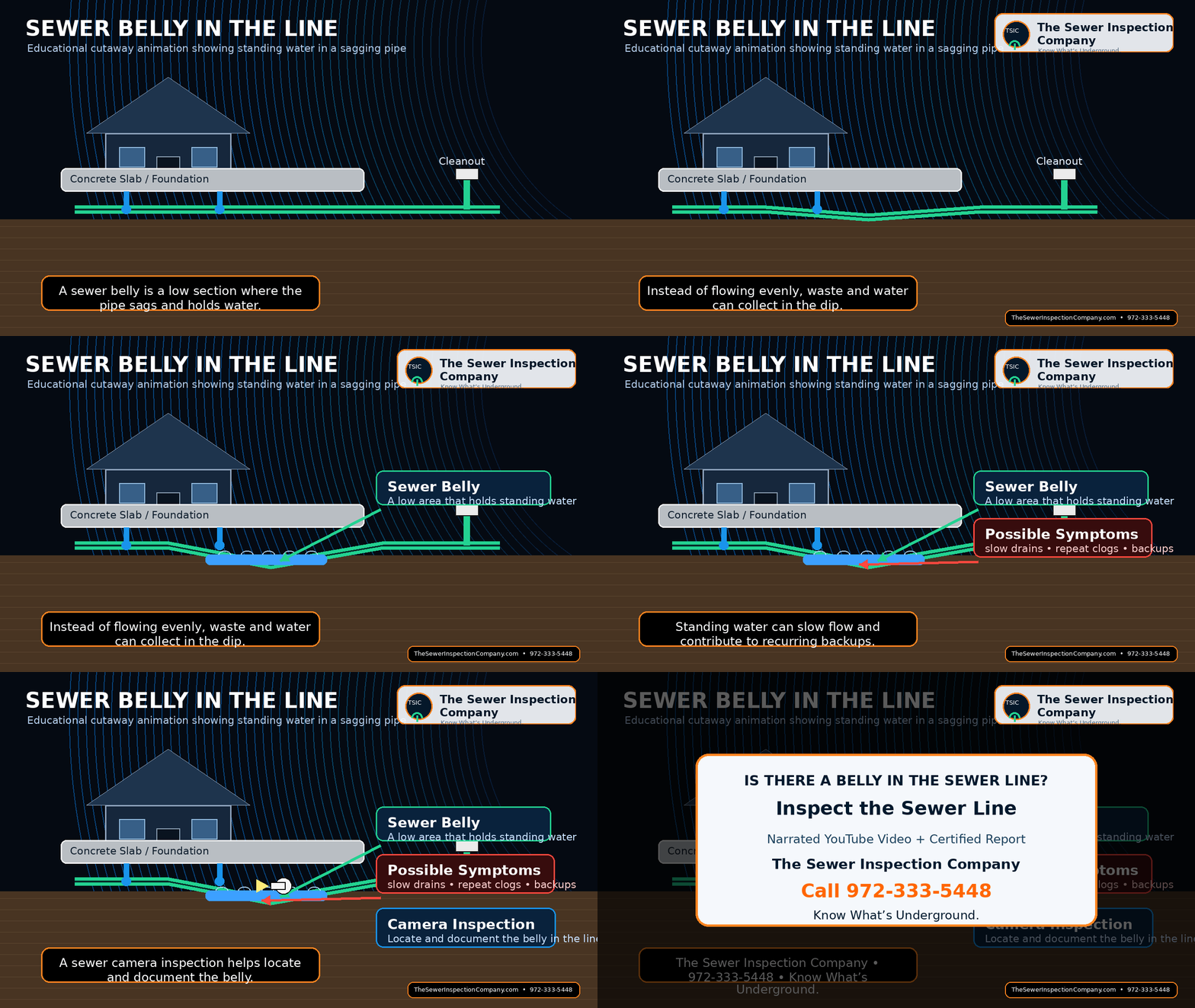
Practical answer: A standard sewer camera does not directly measure pipe slope or grade. It can document standing water, flow behavior, transitions, and visible changes in elevation, but perspective, lens angle, water depth, and pushrod movement prevent the footage alone from serving as a level or survey.
What the video can document
V-SCOPE footage can show the camera entering water, the waterline rising on the lens, the pipe becoming visible again, and whether water remains during withdrawal. Those observations can support a description of a low or submerged section when the pattern is consistent and the view is clear.
Why the lens cannot act like a level
The camera head can tilt, rotate, ride low, or climb deposits. A wide-angle lens alters perspective, and the pushrod may lift the head at a fitting. The apparent angle on screen is therefore not a reliable numeric grade. A Certified Master Plumber Report should separate what is visible from what requires measurement.
Standing water has more than one possible cause
A low section is one possibility, but temporary flow, a downstream restriction, deposits, a sagging pushrod, or a blocked outlet can change the water view. The operator should observe the length, depth pattern, downstream condition, and behavior on both push and withdrawal before describing the evidence.
Footage and surface locating answer different questions
The footage counter estimates cable travel from the access point. The camera-head sonde and surface receiver can estimate the feature’s location and approximate depth. Repeated surface readings may help map a route, but they do not replace elevation shots or a pipe-grade survey.
DFW conditions require local context
A Plano under-slab line may be inaccessible from multiple directions. A Richardson yard line may cross disturbed soil. A Dallas property may combine cast iron and PVC. Material, access, foundation history, and repair records help interpret the video without guessing at an exact slope.
When additional measurement is appropriate
If a purchase, repair design, dispute, or engineering decision depends on numeric grade, ask the appropriate qualified professional what measurement method is needed. The sewer video remains valuable evidence of visible conditions and a reference for targeted follow-up.
Local plumbing-code context
A sewer camera documents visible pipe conditions; it does not certify code compliance or replace required permits and municipal inspections for repair work. The City of Plano’s official building-code page identifies its locally adopted codes. City of Dallas Ordinance 32422 adopted the 2021 International Plumbing Code with Dallas amendments. These are separate local adoptions; neither automatically governs Allen, Frisco, Richardson, Garland, or another jurisdiction.
Related sewer-inspection resources
Seven field-video examples
These field videos show why camera position, narration, footage, locating, and stated limitations matter. Each property needs its own evidence.
Dallas–Fort Worth service area
Appointments are available across DFW, including Plano, Richardson, Allen, Frisco, Dallas, Garland, and nearby communities. Confirm scheduling, cleanout access, utilities, and property access when booking.
Frequently asked questions
Can a sewer camera calculate a percentage grade?
Not from ordinary footage alone. A numeric grade requires an appropriate measurement method.
Does standing water always mean a belly?
No. A restriction, temporary flow, deposits, or camera position can also affect the view.
Can a surface depth reading show slope?
Multiple readings may suggest a route, but approximate depth is not a substitute for verified elevations.
Why inspect on both push and withdrawal?
The second view helps determine whether the water pattern repeats and whether pushrod position affected the first view.
Can running fixtures change the conclusion?
Yes. Active flow changes water level and can hide the pipe wall, so the timing should be narrated.
Does a belly automatically require replacement?
Not automatically. Length, depth, symptoms, material, access, and professional recommendations all matter.
Can the camera show uphill flow?
It can show water movement, but the screen angle alone cannot establish a measured uphill grade.
Should an exact slope appear in a camera report?
Only when supported by a suitable measurement method and clearly identified. The video itself should not be presented as a survey.
Is a sewer scope inspection really necessary?
It is useful before a purchase, renovation, or repair decision and whenever the sewer history is uncertain. It records visible conditions in accessible piping on the inspection date and clearly states what could not be seen.
How long does a sewer scope inspection take?
The booking calendar reserves 90 minutes. Access, pipe length, bends, water, deposits, and visible conditions affect the actual time. Share any inspection deadline when scheduling.
Will I receive a video of the inspection?
Yes. The V-SCOPE service includes narrated video connecting visible conditions to the access point, travel direction, and footage. The report names any section that could not be inspected.
Can a sewer scope detect all problems?
No. Water, debris, sharp turns, inaccessible branches, or a blocked passage can limit visibility. A camera does not show soil or the outside surface of buried pipe.
What happens if problems are found?
The visible condition and its limits are documented. When conditions allow, the camera-head sonde and surface receiver can estimate position and approximate depth so the client can discuss the next step with a qualified repair professional.
Is this service included in a standard home inspection?
Usually not. A general home inspection commonly excludes pushing specialized camera equipment through the building sewer. Confirm each service’s written scope.
How much can sewer repairs cost?
Repair costs vary with location, depth, access, pipe material, length, damage, permits, and restoration. Sewer inspections start at $239; the inspection is not a repair estimate.
Book a documented V-SCOPE sewer inspection
Led by Steven Shipler, RMP #45825, sewer inspections start at $239 and include narrated video and a Certified Master Plumber Report. Locate and approximate depth information are provided when conditions allow. Call 972-333-5448 or choose a time below.
Know What’s Underground, Before You Buy.