
How far can a sewer camera travel? The cable length matters, but access, pipe diameter, bends, deposits, water, restrictions, and the route through the system usually determine the real inspection distance.
How far can a sewer camera travel: start with documented access
A useful sewer inspection begins with the exact access point and agreed route. It uses the camera image, narration, distance, and locating equipment as connected pieces of evidence. The result is a V-SCOPE narrated video plus a Certified Master Plumber Report—not a repair sales pitch.
Cable length is not the same as coverage
A long push cable cannot overcome every fitting or restriction. For example, friction increases through bends, corrugated deposits, offsets, and long runs. Therefore, a camera may travel hundreds of feet in a favorable line or stop much sooner in a small or complicated route. The operator must base the result on the actual footage counter and visible passage, not a marketing maximum.
Access controls the inspection route
A two-way exterior cleanout can provide separate paths toward the house and street. Meanwhile, an interior access may reach under-slab branches that an exterior opening cannot. Plano, Dallas, and Richardson properties vary in age and layout, so the operator should document the cleanout used and avoid assuming one access represents every branch.
Equipment that establishes distance and location
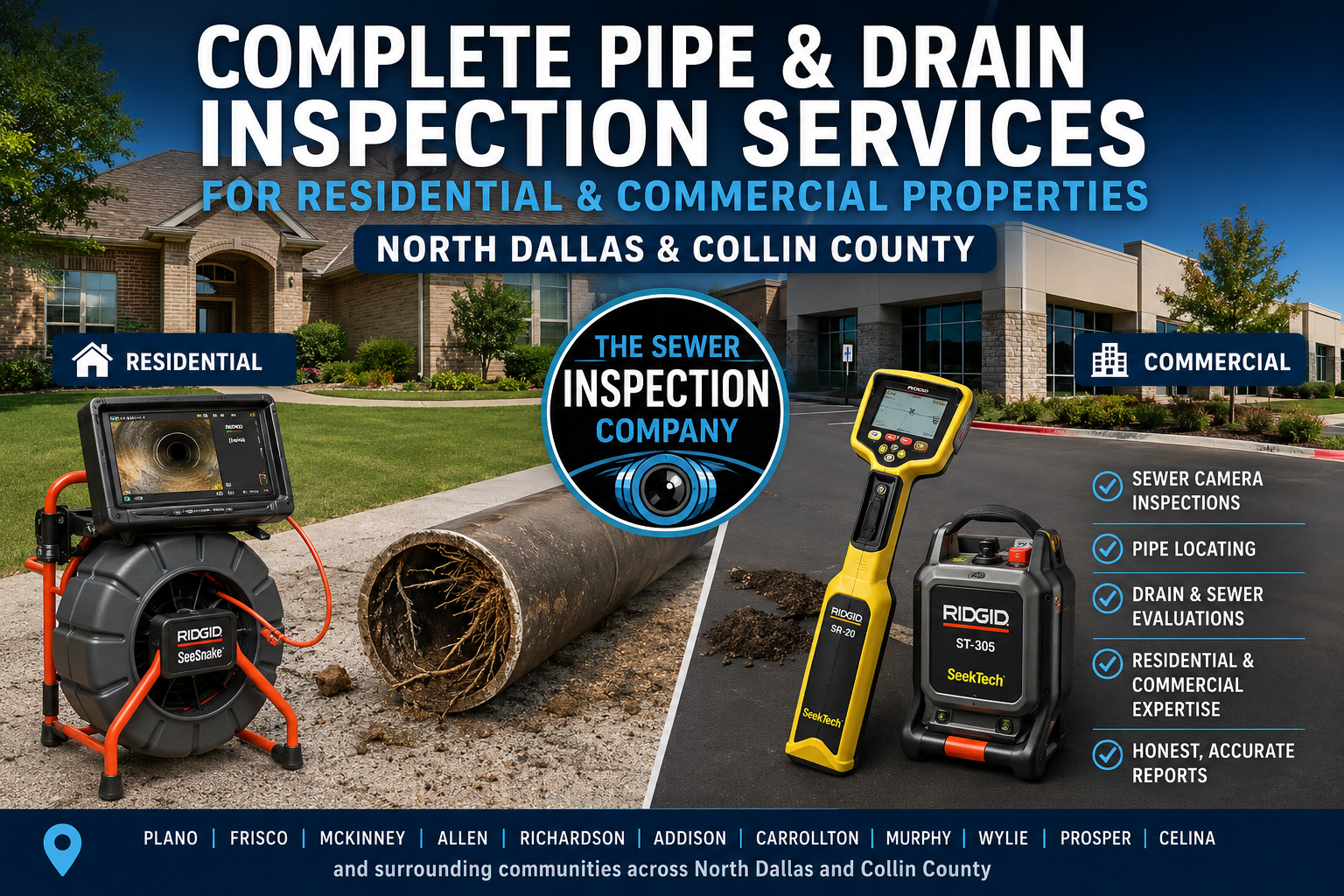
The V-SCOPE self-leveling camera provides the recorded view. Its distance counter estimates cable travel from the starting point. Next, the surface receiver can trace the sonde transmitter in the camera head to estimate location and depth. In addition, comparing the counter with the surface locate helps confirm the route, but neither replaces a survey or excavation verification.
Why water and deposits shorten the useful view
For example, standing water can submerge the lens and hide the lower pipe wall. Likewise, cast-iron scale can reduce the opening and increase friction. Also, roots, grease, soil, and construction debris can stop travel or obscure the image. Therefore, the narrated video should show the limiting condition when possible and state when the camera could not observe beyond it.
What the final report should measure
The Certified Master Plumber Report should include the access point, direction, maximum footage, significant observations, locate information, and uninspected areas. Steven Shipler, Texas Responsible Master Plumber #45825, prepares the report. The standard $239 inspection gives buyers and homeowners documented evidence—not an unsupported claim that the camera viewed every underground pipe.
Local plumbing-code references
Local code adoption applies to installation and repair work; a sewer camera inspection documents visible conditions and does not certify code compliance. The City of Plano’s official code page currently lists its 2024 codes as effective August 1. The City of Dallas Ordinance 32422 adopted the 2021 International Plumbing Code with Dallas amendments and states an effective date of May 12, 2023. These are different local jurisdictions and editions; neither reference should be applied to another city without checking that city’s current adoption and amendments.
Related sewer-inspection resources
- Why locate and depth matter
- Blocked sewer camera inspection
- Under-slab and exterior coverage
- The sewer camera process
Seven field-video examples
These field examples show why narration, access, footage, locating, and stated limitations matter. Each property must be judged from its own accessible evidence.
Dallas–Fort Worth service area
Appointments are available across the DFW area, including Plano, Richardson, Allen, Frisco, Dallas, and nearby communities.
Frequently asked questions
Is there a standard maximum distance for every sewer camera?
No. Equipment capacity varies, and actual travel depends on the pipe and access.
Does a 200-foot cable mean 200 feet will be inspected?
No. Bends, friction, water, deposits, and restrictions may stop the camera sooner.
Can the footage counter be exact?
It is a useful field estimate, but starting position, cable path, and equipment calibration can affect the reading.
Why compare the counter with a surface locate?
The comparison helps tie interior footage to the property layout and identify a significant area from above.
Can the camera inspect every branch line?
Not usually from one access. Branch geometry and fixture connections may prevent entry.
Does the camera reach the city main?
Sometimes, but access direction, distance, connection geometry, and utility boundaries can limit the run.
What if the lens goes underwater?
The submerged section may be only partly visible. Therefore, the report should state the limitation and show where useful visibility ended.
Can a longer cable solve every limitation?
No. More cable does not correct a sharp turn, blocked opening, heavy scale, or unsafe access.
Is a sewer scope inspection really necessary?
Therefore, it is especially useful when a purchase, repeated drainage concern, remodel, or uncertain sewer history makes the accessible building sewer important. A scope provides evidence, not a guarantee that every hidden defect is visible.
How long does a sewer scope inspection take?
Access, pipe length, restrictions, water, deposits, and the findings affect the time. Do not rush a careful inspection. In addition, document important locations and limitations.
Will I receive a video of the inspection?
Yes. The standard V-SCOPE service includes a narrated video so the client can review the accessible sewer and hear the observations in context.
Can a sewer scope detect all problems?
No. The camera shows the accessible interior at the time of inspection. Water, debris, sharp turns, inaccessible branches, or a blocked passage can limit visibility.
What happens if problems are found?
The report documents the visible condition. When appropriate, the sonde and surface receiver can mark an area and estimate depth. The Certified Master Plumber Report helps the client discuss next steps with a repair professional.
Is this service included in a standard home inspection?
Usually not. A general home inspection commonly does not include pushing specialized camera equipment through the building sewer. Confirm the written scope of every service.
How much can sewer repairs cost?
Repair costs vary widely with the location, depth, access, pipe material, length, damage, and restoration required. The $239 inspection is not a repair quote; documented evidence helps contractors price the actual condition.
Book a documented V-SCOPE sewer inspection
The standard inspection price is $239. Call 972-333-5448 or choose a time below.
Know What’s Underground, Before You Buy.