
Want to know what’s going on inside your sewer line? Call The Sewer Inspection Company for a plumbing and sewer inspection in Dallas. A camera is the only way to see what is really happening underground.
Call Now: 972-333-5448Know What’s Underground, Before You Buy.
See What’s Inside Your Dallas Sewer Line
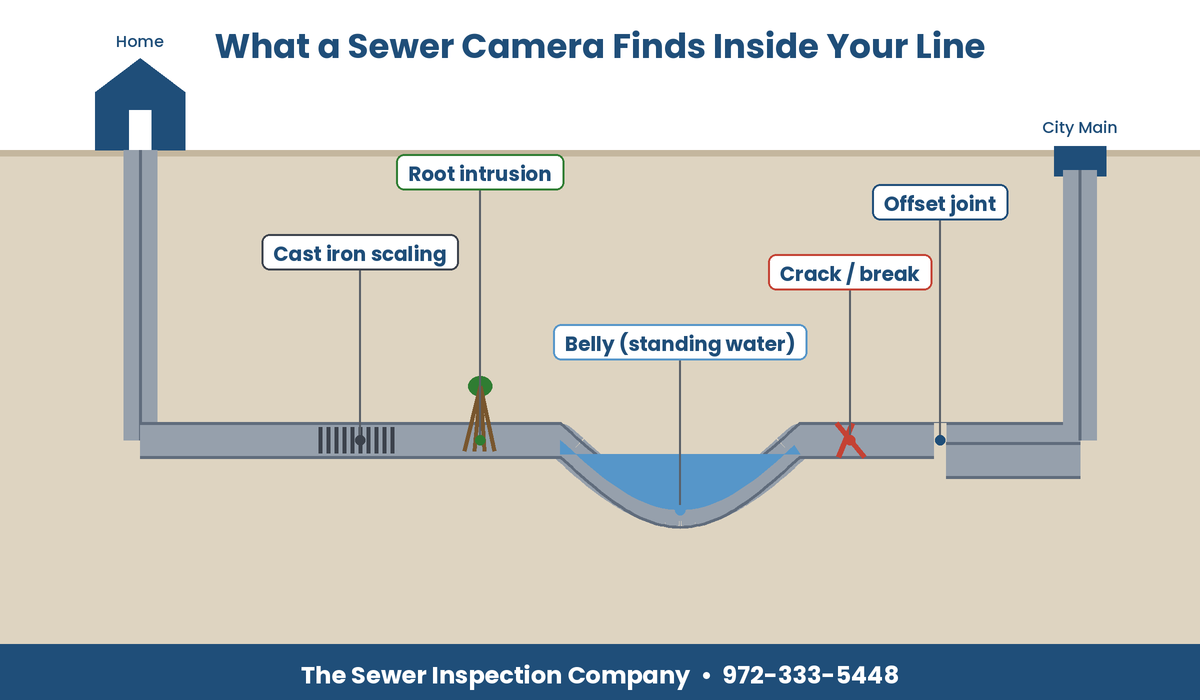
Your sewer line does its job out of sight, right up until it does not. By the time you notice a backup or a smell, the problem has usually been building underground for a while. A plumbing and sewer inspection puts a high-resolution camera inside the line so you can see exactly what is there, roots, bellies, offsets, cast iron buildup, cracks, or a clean pipe with nothing to worry about. If you want to see what that footage looks like, our Ultimate Guide to Sewer Inspection Videos walks through real examples.
I got a call from a homeowner in East Dallas whose kitchen sink kept backing up every few weeks. Three different plumbers had snaked it and called it good. We dropped a camera in and the answer was right there on the screen: a belly holding water about forty feet out, collecting grease every time it drained. No amount of snaking was ever going to fix that. Seeing inside the line turned a recurring mystery into a clear, one-time repair. That is what a camera does.
Signs Something’s Wrong Inside Your Sewer Line
If you are noticing any of these, it is worth looking inside the line:
- Slow drains in more than one fixture at the same time.
- Gurgling from toilets or drains when water runs elsewhere.
- Repeated backups that come back no matter how often you snake them.
- Sewer smell inside the house or out in the yard.
- A soggy or sunken spot in the yard over the sewer line.
- An older home with original cast iron or clay drain lines.
Need a Plumbing & Sewer Inspection in Dallas?
Call or schedule online. We put a camera in the line, record it, and show you exactly what is there.
Schedule Online Call Now: 972-333-5448What a Sewer Inspection Shows
Every line is different, but in Dallas these are the issues we see most. Our sewer inspection video library has real examples of each:
- Root intrusion at joints, common with Dallas’s older trees and clay pipe.
- Bellies where the line sags and holds water and waste instead of draining clean.
- Offset or separated joints from soil movement.
- Cast iron deterioration and heavy scaling that narrows the pipe from the inside.
- Cracks, breaks, and collapses that often mean digging, not just cleaning.
- Standing water that points to a low spot or a downstream blockage.
Watch: Real Sewer Inspection Videos
These are real sewer camera inspections, the same kind of footage you would get on your Dallas home. See the difference between a clean line and one full of roots, bellies, offsets, and cast iron damage. For the full set with explanations, see our Ultimate Guide to Sewer Inspection Videos.
Sewer Inspection Video 1
Sewer Inspection Video 2
Sewer Inspection Video 3
Sewer Inspection Video 4
Sewer Inspection Video 5
Sewer Inspection Video 6
Why Dallas Sewer Lines Deserve a Camera
Dallas has a lot of established neighborhoods, and with age comes aging pipe. Several things specific to this area make a camera inspection worth it:
- Older homes with cast iron and clay. Cast iron scales and rusts from the inside, and clay joints are an open invitation to roots. A lot of it across Dallas is now near the end of its life.
- North Texas clay soil. It swells when wet and shrinks when dry, and that constant movement is what creates bellies and offset joints.
- Mature trees. The big trees that make Dallas streets beautiful are also sending roots toward the water inside an aging sewer pipe.
One of my favorite calls was a homeowner near White Rock Lake who was bracing for a full line replacement after a scary quote from someone else. We ran the camera and the line was honestly in good shape, just one root ball at a single joint. A cleaning and a follow-up plan, not a teardown. He almost spent thousands he did not need to. Looking inside first saved him the whole bill.
How the Inspection Works
It is quick and clean, usually 30 to 45 minutes. We find the cleanout, push a professional camera through the line, and record the full run. If we find a problem, we locate it so you know exactly where it is and how deep, which means any repair quote is based on a real spot instead of a guess. The equipment we use:
- RIDGID SeeSnake camera and reel for clear, high-resolution video of the full line.
- RIDGID SeekTech SR-20 locator to mark the exact position of a defect at the surface.
- RIDGID SeekTech ST-305 line transmitter to trace the path and depth of the pipe.
Dallas Areas We Inspect
We cover all of Dallas, from East Dallas, Lakewood, and the M Streets to North Dallas, Oak Cliff, and everywhere in between. If you are nearby in Plano, Frisco, or McKinney, we inspect there too.
Call Now: 972-333-5448Know What’s Underground, Before You Buy.
Dallas Sewer Inspection FAQ
How do I know if I need a sewer inspection?
Repeated backups, slow drains in several fixtures, gurgling, sewer smell, or a soggy spot in the yard are all good reasons. So is buying or selling an older Dallas home. Call 972-333-5448 if you are not sure.
How long does the inspection take?
Usually 30 to 45 minutes from start to finish, including recording the video and locating any problem we find.
Do I get to see the video?
Yes. You get a recording of the full inspection to keep, review, and share with a plumber or your agent.
What if you find a problem?
You get the video, a clear explanation of what it shows, and the located position of the defect, so you can make an informed decision about the repair instead of guessing.
Dallas City References
For Dallas-specific permitting, inspection, and code details, these local resources apply:
- City of Dallas, Plumbing and Mechanical Inspections.
- City of Dallas, Building Inspection and permitting requirements.
- City of Dallas, Code Compliance Services.
Tools and Equipment Used
The professional equipment behind every Dallas inspection:
- RIDGID SeeSnake sewer inspection cameras and reels (high-resolution sewer line video).
- RIDGID SeekTech SR-20 locator (surface location of pipe defects).
- RIDGID SeekTech ST-305 line transmitter (pipe path and depth tracing).
Plumbing Code Reference Section (IPC & UPC)
The 2024 International Plumbing Code (IPC) and 2024 Uniform Plumbing Code (UPC) are the current model editions for sanitary drainage, cleanouts, vents, traps, and building-sewer requirements. These ten references provide the code context behind a plumbing and sewer inspection. For the full reference library, see the code section of our Ultimate Guide to Sewer Inspection Videos.
| # | Code Reference | Why It Matters for a Sewer Inspection |
|---|---|---|
| 1 | 2024 IPC, Full Code | General International Plumbing Code reference for residential plumbing. |
| 2 | 2024 IPC, Chapter 3 General Regulations | Testing, inspection, and protection requirements for plumbing systems. |
| 3 | 2024 IPC, Chapter 7 Sanitary Drainage | Core building-sewer, drainage, and cleanout provisions an inspection checks. |
| 4 | 2024 IPC, Chapter 10 Traps, Interceptors and Separators | Trap, sewer gas, and interceptor context tied to drainage performance. |
| 5 | 2024 IPC, Chapter 9 Vents | Venting that supports proper drainage flow and trap protection. |
| 6 | 2024 IPC, Chapter 11 Storm Drainage | Exterior drainage often confused with sewer issues during an inspection. |
| 7 | 2024 UPC, Full Code | Uniform Plumbing Code reference for sanitary drainage and plumbing standards. |
| 8 | 2024 UPC, Drainage Systems | Building-sewer sizing, slope, and drainage requirements. |
| 9 | 2024 UPC, Cleanouts | Cleanout placement and access, the entry point for a camera inspection. |
| 10 | 2024 UPC, Inspection and Testing | Inspection and testing provisions relevant to verifying a sewer line. |
Know What’s Going On Inside Your Sewer Line
Call The Sewer Inspection Company for a plumbing and sewer inspection in Dallas.
Schedule Online Call Now: 972-333-5448