
When a sewer camera stops at a sharp bend, the stopping point is evidence—but it is not automatically proof of a break, blockage, or collapsed pipe. Camera size, pipe diameter, fitting geometry, offsets, deposits, and the selected access point all affect how far the push cable can travel.
Sewer camera stops at a sharp bend: start with documented access
A useful sewer inspection begins with the exact access point and agreed route. It uses the camera image, narration, distance, and locating equipment as connected pieces of evidence. The result is a V-SCOPE narrated video plus a Certified Master Plumber Report—not a repair sales pitch.
Why a sharp bend can stop the camera
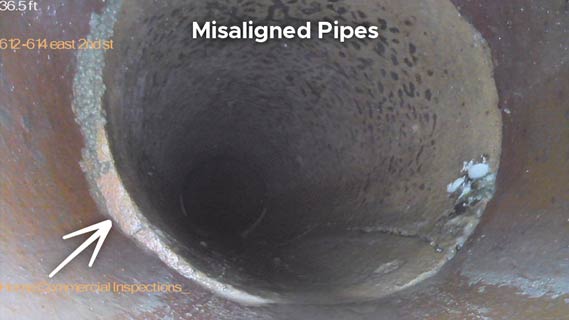
A sewer camera can move through ordinary drainage fittings. However, real systems are not always ideal. A tight change of direction, back-to-back fittings, a branch connection, a reduced opening, scale, or a misaligned joint can resist the camera head. Forcing the cable risks damaging equipment or lodging the head. The operator should stop when resistance makes continued travel unsafe.
When a sewer camera stops at a sharp bend, the stopping point is not the diagnosis
Therefore, a repeatable stop at the same footage narrows the question. It does not, by itself, identify the cause. The final visible frames may show a fitting, standing water, deposits, an offset edge, or only a dark turn. In addition, the narrated video should separate visible evidence from operator inference. For example, “camera travel ended at 47 feet” is more defensible than declaring an unseen collapse.
How an alternate access changes the evidence
Meanwhile, a second cleanout or an access point from the opposite direction may let the camera approach the same area differently. In Plano, a front-yard cleanout might show the exterior lateral toward the city connection, while an interior or two-way access may be needed to view piping back toward the house. Richardson and Allen homes can have different layouts, so the operator must document the actual route rather than assume it.
Use the distance counter and locate together
The V-SCOPE self-leveling camera supplies the interior image. Its distance counter gives travel context. Next, the surface receiver can trace the camera head’s sonde transmitter to estimate horizontal position and depth. Those three equipment references should agree reasonably. However, signal conditions and site features still affect the locate estimate.
What the report should say
A useful Certified Master Plumber Report states the entry point, direction, maximum footage, final visible condition, locate result, and the section not inspected. The report should also note whether the operator attempted an alternate access or found none available. Steven Shipler, Texas Responsible Master Plumber #45825, prepares the report so a buyer or homeowner can separate confirmed footage from an unresolved limitation.
Local plumbing-code references
Local code adoption applies to installation and repair work; a sewer camera inspection documents visible conditions and does not certify code compliance. The City of Plano’s official code page currently lists its 2024 codes as effective August 1. The City of Dallas Ordinance 32422 adopted the 2021 International Plumbing Code with Dallas amendments and states an effective date of May 12, 2023. These are different local jurisdictions and editions; neither reference should be applied to another city without checking that city’s current adoption and amendments.
Related sewer-inspection resources
- How blocked sewer inspections are documented
- Why locate and depth matter
- What a sewer camera inspection can show
- Where a sewer cleanout may be located
Seven field-video examples
These field examples show why narration, access, footage, locating, and stated limitations matter. Each property must be judged from its own accessible evidence.
Dallas–Fort Worth service area
Appointments are available across the DFW area, including Plano, Richardson, Allen, Frisco, Dallas, and nearby communities.
Frequently asked questions
Does a sharp bend mean the sewer was installed incorrectly?
Not necessarily. Instead, evaluate the visible geometry and the locally adopted code at the time of construction separately. A scope alone does not certify installation compliance.
Should the operator force the camera around the bend?
No. Excessive force can damage the camera, cable, or pipe and can leave equipment stuck underground.
Can a smaller camera pass where the V-SCOPE camera stops?
Sometimes a different camera head can negotiate a tighter route, but image quality, locating capability, and pipe size still matter.
Can the bend be located from the surface?
If the sonde signal is usable, a receiver can estimate the position and depth of the camera head at the stopping point.
Does standing water at the bend prove a sewer belly?
No. Flow, geometry, debris, or grade may influence the water level. A belly conclusion requires adequate footage and context.
Can a cleanout from the other direction solve the access problem?
It may. A second access can approach the same area from the opposite side and reduce uncertainty.
What if no alternate access exists?
The report should identify the uninspected section. Therefore, it should explain when the investigation requires additional access or another method.
Can the stopping distance be used for excavation?
It is a starting reference, not a survey. Therefore, use a surface locate and site verification to support repair planning.
Is a sewer scope inspection really necessary?
It is especially useful when a purchase, repeated drainage concern, remodel, or uncertain sewer history makes the accessible building sewer important. A scope provides evidence, not a guarantee that every hidden defect is visible.
How long does a sewer scope inspection take?
Access, pipe length, restrictions, water, deposits, and the findings affect the time. Do not rush a careful inspection. In addition, document important locations and limitations.
Will I receive a video of the inspection?
Yes. The standard V-SCOPE service includes a narrated video so the client can review the accessible sewer and hear the observations in context.
Can a sewer scope detect all problems?
No. The camera shows the accessible interior at the time of inspection. Water, debris, sharp turns, inaccessible branches, or a blocked passage can limit visibility.
What happens if problems are found?
The report documents the visible condition. When appropriate, the sonde and surface receiver can mark an area and estimate depth. The Certified Master Plumber Report helps the client discuss next steps with a repair professional.
Is this service included in a standard home inspection?
Usually not. A general home inspection commonly does not include pushing specialized camera equipment through the building sewer. Confirm the written scope of every service.
How much can sewer repairs cost?
Repair costs vary widely with the location, depth, access, pipe material, length, damage, and restoration required. The $239 inspection is not a repair quote; documented evidence helps contractors price the actual condition.
Book a documented V-SCOPE sewer inspection
The standard inspection price is $239. Call 972-333-5448 or choose a time below.
Know What’s Underground, Before You Buy.