
A remodel changes finishes and fixtures; it can also make future sewer access easier, harder, or much more expensive.
Before a kitchen expansion, bathroom addition, slab opening, or whole-house renovation, homeowners often focus on visible plans. The buried building sewer deserves a separate baseline. A camera inspection can document accessible conditions before work begins, identify where the line runs, and flag questions that should be resolved with the remodel plumber or designer.
Why timing before demolition matters
A renovation may add fixture load, reroute drains, cover an existing cleanout, or place expensive finishes over a line with unresolved concerns. An early scope can show the accessible interior and help identify whether additional professional evaluation belongs in the project schedule. If the camera cannot reach a segment, the team learns that before finalizing assumptions.
A locate can also provide a surface reference for the line route and approximate depth at selected points. That information is useful for planning, but it is not a substitute for utility locating, engineered design, or careful excavation. The camera route follows the pipe interior; it does not map every underground utility.
Four planning questions the report can answer
- Which accessible sewer segment was observed and from what entry point?
- What pipe materials or transitions were visible?
- Were there conditions that could affect construction sequencing or further evaluation?
- Where were selected features located from the surface, and what limitations remain?
For a Plano addition, that record gives the design and plumbing teams better starting information. A Richardson bathroom remodel or Allen slab project may face different local requirements, but the same principle applies: diagnose first, then let the responsible professionals design, permit, and perform the work.
Keep inspection, design, and permitting separate
The Certified Master Plumber Report documents observations. It does not replace construction drawings, permit review, load calculations, or the repair contractor’s scope. When findings matter to the remodel, share the video and report with the licensed plumber and the authority having jurisdiction before work is concealed.
After major underground or under-slab work, a separate post-work inspection may be useful to document the accessible condition at that later date. The before-and-after records should never be described as identical tests if access, cleaning, or the pipe route changed.
What the V-SCOPE inspection documents
The inspection uses a self-leveling camera head to record the accessible interior of the sewer line. A distance counter helps relate observations to footage traveled. When a feature needs to be located, a sonde transmitter in the camera assembly can be traced from the surface with a receiver to estimate position and depth. Those tools work together: the camera supplies visual evidence, the counter supplies distance context, and the locator supplies a surface reference.
The deliverables include a narrated video and a Certified Master Plumber Report prepared under Steven Shipler, Texas Responsible Master Plumber #45825. The report describes observed conditions without inventing a repair scope. If access or visibility prevents a complete look, that limitation should be stated instead of treated as a clean bill of health.
Local plumbing-code references
Plano adopts the 2024 IPC with amendments (City Code §6-237). Its amended IPC §305.4.1 sets a 12-inch minimum building-sewer depth. A camera scope does not certify code compliance or independently prove burial depth. Verify other cities’ adopted rules separately.
Related homeowner resources
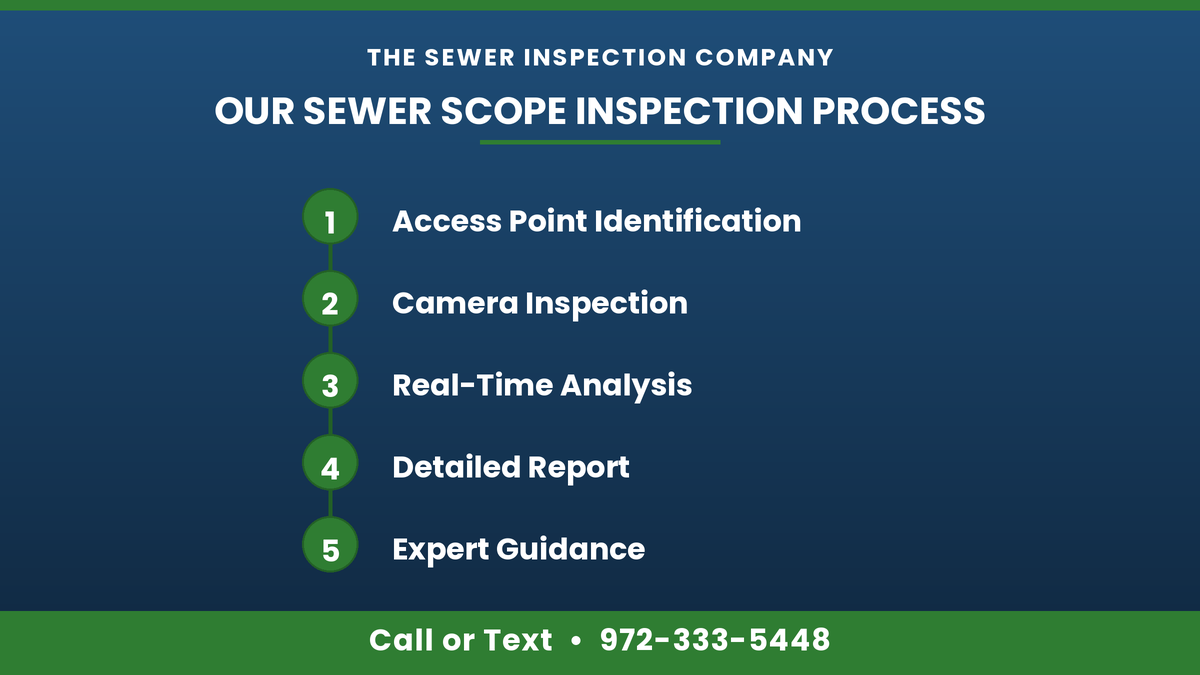
- See the sewer camera and scope inspection process
- Learn what a sewer camera can show
- Review the current inspection price and service
- Read customer testimonials
Seven field-video examples
These examples show why the recorded view, narration, distance, and access limitations matter. Each line has to be judged from its own accessible evidence.
What customers say
“Excellent experience. They arrived prepared, inspected the sewer line carefully, and documented everything they found. I really appreciated having the video and a clear explanation of what was happening underground instead of just being told everything looked fine.”
— Cameron Liingle
“Great sewer inspection service. They took the time to properly inspect the entire accessible sewer line instead of rushing through it. The findings were clearly explained, and having a written report from a Master Plumber made it much easier to understand what needed to happen next.”
— Mark Ryan
Service area
Appointments are available across the Dallas–Fort Worth area, including Plano, Richardson, Allen, Frisco, and surrounding communities.
Frequently asked questions
How early should I schedule the scope?
Schedule it while plans can still change and before finishes or site work make access more difficult.
Can the scope approve my remodel design?
No. It documents accessible conditions. Design, sizing, permits, and code compliance belong to the responsible design and plumbing professionals and local authority.
Will the camera map every drain branch?
No. Camera access depends on cleanouts, turns, diameter, and configuration. The report should identify what was and was not reached.
Can a locate replace 811 utility marking?
No. A camera-head locate follows the sewer at selected points; it does not identify all utilities. Use the proper utility-locating process before excavation.
Should I scope before cutting a slab?
If the sewer condition or route could affect the plan, a pre-work scope and locate may reduce uncertainty. The contractor must still verify conditions before cutting.
What records should I give my remodel plumber?
Provide the narrated video, report, locate notes, and any access limitations, along with prior repair or cleaning records.
Is a second inspection useful after the work?
It can be useful when you need a dated record of the accessible line after work, especially if the route or access changed.
Does a clear pre-remodel video guarantee future performance?
No. It records a moment in time and the segment that was accessible. Construction and later use can change conditions.
Is a sewer scope inspection really necessary?
It is especially useful when a home purchase, repeated stoppage, major remodel, or unclear drain history makes the condition of the accessible building sewer important. A scope is diagnostic evidence, not a promise that every hidden defect will be visible.
How long does a sewer scope inspection take?
Access, pipe length, water or debris, and the findings affect the time. The inspection should not be rushed; the camera must be advanced carefully and significant locations documented.
Will I receive a video of the inspection?
Yes. The service includes a narrated video so you can review the accessible line and understand what the camera operator saw.
Can a sewer scope detect all problems?
No. A camera shows the interior of the accessible pipe at the time of inspection. Standing water, heavy deposits, sharp turns, inaccessible branches, or a blocked passage can limit visibility.
What happens if problems are found?
The finding is documented, and a sonde locator and surface receiver can be used when appropriate to mark an area and estimate depth. A Certified Master Plumber Report helps you discuss next steps with the right repair professional.
Is this service included in a standard home inspection?
Usually not. A general home inspection commonly does not include pushing a specialized sewer camera through the building sewer, so confirm the scope of each service.
How much can sewer repairs cost?
Costs vary widely with location, depth, access, pipe material, damage extent, and repair method. The inspection fee is not a repair estimate; documented evidence helps contractors price the actual condition instead of guessing.
Book a documented sewer inspection
The standard inspection price is $239. Call 972-333-5448 or choose a time below.
Know What’s Underground, Before You Buy.