
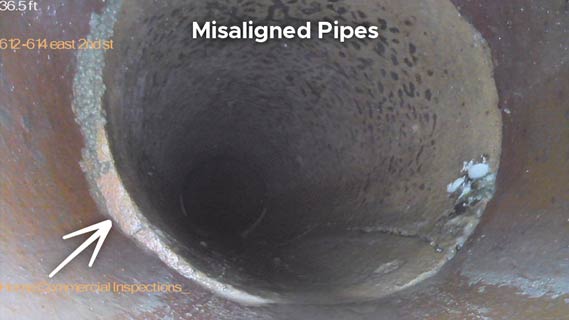
Practical answer: A camera that stops at a suspected dropped or offset joint confirms a travel limit, not the condition of every pipe beyond it. The V-SCOPE video should show the approach, alignment change, resistance, footage counter, access direction, and any surface locate. Never force the camera past a hard obstruction.
What a dropped or offset joint can look like
The lens may show an abrupt ledge, a shifted pipe opening, exposed joint edge, standing water, or debris collecting at one side. Perspective can exaggerate an offset, so the narrated video should include the approach from several feet away and a controlled close view. A single frame cannot prove how far the sections moved or what the exterior soil looks like.
Why the stop point matters
When the camera head cannot pass, the line beyond that location remains uninspected from that access. Steven Shipler documents the access point, direction, footage reached, and reason for stopping. That boundary belongs in the Certified Master Plumber Report so a buyer in Plano or Richardson does not mistake partial footage for full coverage.
Use three measurements together
The V-SCOPE footage counter estimates cable travel. The camera-head sonde sends a signal, and a surface receiver estimates ground position and depth. Together, those equipment readings provide a repair-planning reference. However, cable footage is not surveyed distance, and signal conditions can affect the locate.
Do not force the camera
Pushing harder can lodge the head, damage equipment, or disturb already weakened material. A safe inspection uses controlled advancement and withdrawal. If the head repeatedly meets the same rigid edge, the next step may require a second access, cleaning by the proper contractor, or a repair evaluation—not more force.
How a second direction changes the evidence
A second cleanout or approved access may approach the same location from the opposite direction. That can show the far side of the joint and clarify whether the restriction is local. It still does not guarantee that every branch between Allen, Frisco, or any other property layout becomes accessible.
What the report should separate
The report should distinguish observed facts from interpretation: visible offset, passage limit, water, debris, locate result, and uninspected length are facts. Cause, repair method, and exterior condition may require additional work. That separation keeps the footage useful for contractors and real-estate decisions.
Local plumbing-code references
A camera inspection documents visible conditions; it does not certify code compliance or replace permits and inspections for repair work. The City of Plano’s official code page lists its locally adopted 2024 codes as effective August 1. City of Dallas Ordinance 32422 adopted the 2021 International Plumbing Code with Dallas amendments, effective May 12, 2023. These are separate local adoptions; neither automatically governs Allen, Frisco, Richardson, Garland, or another jurisdiction.
Related sewer-inspection resources
Seven field-video examples
These field videos show why access, narration, footage, locating, and stated limitations matter. Each property requires its own evidence.
Dallas–Fort Worth service area
Appointments are available across the DFW area, including Plano, Richardson, Allen, Frisco, Dallas, Garland, and nearby communities.
Frequently asked questions
Does a stop point prove the joint has collapsed?
No. It proves the camera could not pass under the inspection conditions. The visible geometry may suggest an offset, but collapse requires visible evidence or other confirmation.
Can the camera be pushed harder?
It should not be forced against a hard obstruction. Controlled handling protects the pipe and the equipment.
Can the joint be located from the surface?
Often the sonde and receiver can estimate position and depth if signal conditions allow.
Does footage equal exact horizontal distance?
No. Cable bends, access geometry, and pipe route make footage an estimate rather than a survey.
Will a second cleanout help?
It may provide another direction and show the far side of the obstruction, depending on the plumbing layout.
Can cleaning make the joint passable?
Cleaning can remove debris, but it does not realign pipe. The method must suit the pipe material and condition.
What remains unknown after the camera stops?
The interior beyond the stopping point, inaccessible branches, exterior soil, and hidden pipe-wall condition remain unknown.
Should the report call for immediate replacement?
Not from a stop point alone. The visible condition, symptoms, extent, access, and repair professional’s evaluation guide the next step.
Is a sewer scope inspection really necessary?
It is especially useful before a purchase, remodel, or repair decision, and when the sewer history is uncertain. The scope documents visible conditions in the accessible piping; it cannot guarantee that every concealed defect will appear.
How long does a sewer scope inspection take?
Access, pipe length, bends, deposits, water, and findings affect the time. A careful inspection should document important locations and limitations instead of rushing through the line.
Will I receive a video of the inspection?
Yes. The standard V-SCOPE service includes a narrated video that connects visible conditions to the access point, direction of travel, and footage.
Can a sewer scope detect all problems?
No. The camera shows the accessible pipe interior at the time of inspection. Water, debris, sharp turns, inaccessible branches, or a blocked passage can limit visibility.
What happens if problems are found?
The report documents the visible condition. When appropriate, the camera-head sonde and surface receiver can mark an area and estimate depth. The Certified Master Plumber Report helps the client discuss the next step with a repair professional.
Is this service included in a standard home inspection?
Usually not. A general home inspection commonly does not include pushing specialized camera equipment through the building sewer. Confirm the written scope of every service.
How much can sewer repairs cost?
Repair costs vary widely with location, depth, access, pipe material, length, damage, and restoration. The $239 inspection is not a repair quote; documented evidence helps a contractor price the actual condition.
Book a documented V-SCOPE sewer inspection
Led by Steven Shipler, Texas Master Plumber #45825, the standard V-SCOPE inspection is $239 and includes a narrated video, locate/depth information when conditions allow, and a Certified Master Plumber Report. Call 972-333-5448 or choose a time below.
Know What’s Underground, Before You Buy.