What Is the Proper Slope of a Residential Sewer Line for a 3-Inch and 4-Inch Pipe?
Explained by a Licensed Master Plumber
Know What’s Underground, Before You Buy.
Sewer line slope is one of the most important parts of a properly working residential sewer system. A sewer line does not use pressure to move waste away from the house. It uses gravity. That means the pipe must be installed with the correct fall from the house toward the city sewer, city tap, or septic system.
If the pipe is too flat, wastewater and solids can sit in the pipe. If the pipe has dips, sags, or bellies, the sewer line can hold water and collect waste. If the pipe is installed poorly, it may technically move water at first but still create drain problems later.
As a Licensed Master Plumber, I look at more than just whether water moves through the pipe. I look at slope, grade, bedding, fittings, cleanout access, transitions, compaction, and whether the sewer line will keep working properly after it is covered up.
Quick Answer
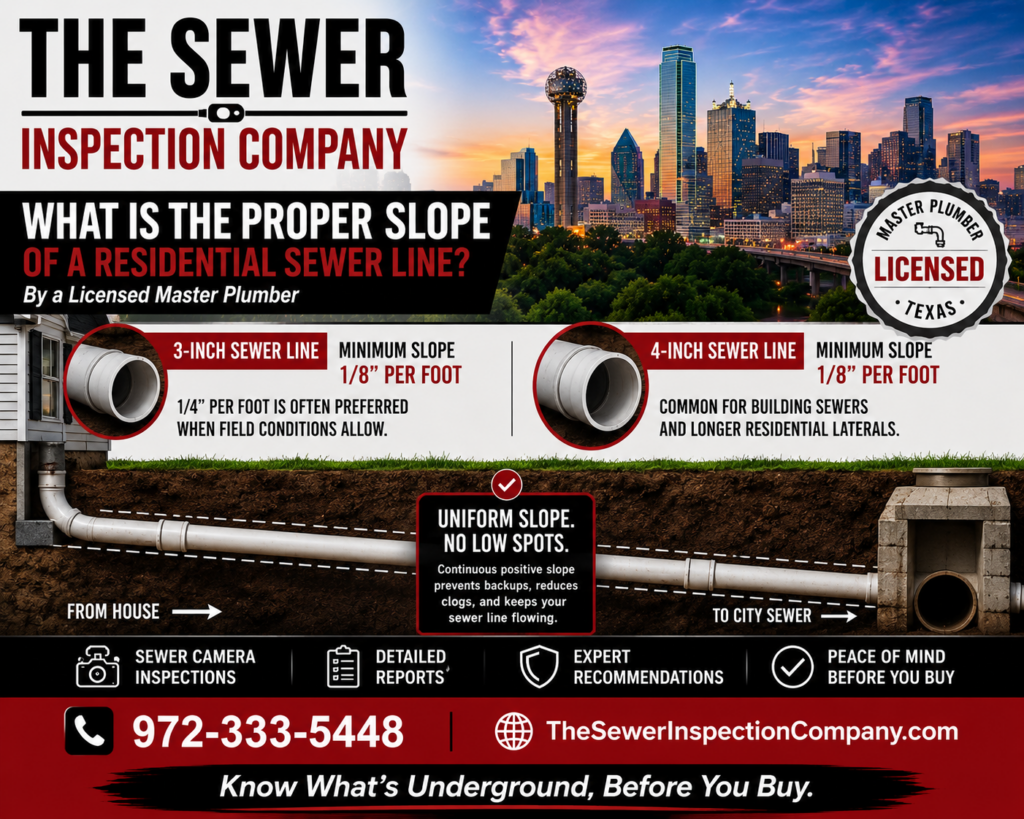
Under IPC-style slope tables, 3-inch through 6-inch horizontal drainage piping is commonly listed at a minimum slope of 1/8 inch per foot.
Under UPC-style guidance, 4-inch and larger building drains may commonly be allowed at 1/8 inch per foot under table and fixture-unit conditions, while 3-inch pipe is commonly treated more conservatively and often installed at 1/4 inch per foot.
The safest field answer: verify the local adopted code, the city amendments, and the inspector’s requirement before installing or repairing the sewer line.
Master Plumber Note
Do not treat slope as a guess. The proper sewer line slope depends on the adopted plumbing code, pipe size, fixture-unit load, local amendments, site conditions, and inspection requirements. The city inspector and the adopted local code are the final authority.
Residential Sewer Line Slope Chart
The following is a practical field reference for common residential sewer line slope. This is not a substitute for the adopted local plumbing code.
| Pipe Size | IPC-Style Common Minimum | UPC-Style Field Note |
|---|---|---|
| 3-inch sewer pipe | Commonly 1/8 inch per foot under IPC Table 704.1 for 3-inch to 6-inch pipe. | Often treated more conservatively. Many plumbers install 3-inch pipe at 1/4 inch per foot when conditions allow. |
| 4-inch sewer pipe | Commonly 1/8 inch per foot under IPC Table 704.1 for 3-inch to 6-inch pipe. | Commonly allowed at 1/8 inch per foot under UPC table conditions for 4-inch and larger building drains, subject to fixture-unit and scouring requirements. |
In the real world, a 1/4 inch per foot slope is often preferred on shorter residential runs when there is enough fall available. However, a 1/8 inch per foot slope can be code-compliant for certain 3-inch and 4-inch drainage piping under the IPC and for certain 4-inch and larger drainage piping under UPC-related guidance.
What Does “1/8 Inch Per Foot” Mean?
A slope of 1/8 inch per foot means the pipe drops 1/8 inch vertically for every 1 foot of horizontal run.
For example:
- 10 feet of pipe at 1/8 inch per foot drops 1.25 inches.
- 20 feet of pipe at 1/8 inch per foot drops 2.5 inches.
- 40 feet of pipe at 1/8 inch per foot drops 5 inches.
- 60 feet of pipe at 1/8 inch per foot drops 7.5 inches.
That may not sound like much, but it can be enough fall for properly sized horizontal drainage pipe when the pipe is installed in uniform alignment, properly supported, and approved by the adopted code.
What Does “1/4 Inch Per Foot” Mean?
A slope of 1/4 inch per foot means the pipe drops 1/4 inch vertically for every 1 foot of horizontal run.
For example:
- 10 feet of pipe at 1/4 inch per foot drops 2.5 inches.
- 20 feet of pipe at 1/4 inch per foot drops 5 inches.
- 40 feet of pipe at 1/4 inch per foot drops 10 inches.
- 60 feet of pipe at 1/4 inch per foot drops 15 inches.
On shorter residential runs, 1/4 inch per foot can be an excellent slope when there is enough elevation to make it work. On longer runs, there may not always be enough available fall from the house to the city tap, so 1/8 inch per foot may be necessary and code-compliant where allowed.
Why Proper Sewer Line Slope Matters
A residential sewer line needs enough slope to carry wastewater and solids together. The goal is not just to move water. The goal is to move water, toilet paper, waste, and debris all the way to the city sewer or septic system.
If the pipe is too flat, the water does not move with enough velocity. Solids can settle in the pipe. Over time, that can create buildup, slow drains, odors, and recurring stoppages.
If the pipe has low spots or sags, water can sit in the pipe. That is what we call a sewer belly. A belly can hold wastewater for several feet, and that low section becomes a collection point for waste.
The Rule That Matters in the Field
The sewer line must have continuous positive slope. No flat spots. No backfall. No dips. No bellies. No standing water.
Proper Slope for a 3-Inch Residential Sewer Line
A 3-inch residential sewer line is commonly used for building drains, toilet branches, and some residential sewer applications depending on the layout and local code requirements.
Under IPC-style slope tables, 3-inch horizontal drainage piping is commonly listed with a minimum slope of 1/8 inch per foot. That does not automatically mean every 3-inch pipe on every job should be installed at 1/8 inch per foot. The local code, inspector, pipe use, fixture load, and field conditions still matter.
From a practical Master Plumber standpoint, I often prefer 3-inch pipe at 1/4 inch per foot when the job allows it. That stronger slope can help carry waste better on shorter residential runs.
The mistake is not choosing 1/8 or 1/4. The mistake is having inconsistent grade. A 3-inch line with a dip, sag, or back-pitched section can become a problem even if part of the line was installed correctly.
Proper Slope for a 4-Inch Residential Sewer Line
A 4-inch sewer line is common for residential building sewers and main sewer laterals. It gives more capacity and is often used from the house to the city tap.
Under IPC-style slope tables, 4-inch horizontal drainage piping is commonly listed with a minimum slope of 1/8 inch per foot. UPC-related guidance also recognizes 1/8 inch per foot for 4-inch and larger building drains under table conditions and fixture-unit limitations.
That said, 1/4 inch per foot is also acceptable in many cases and can be preferred when field conditions allow. The key is uniform positive grade. The pipe should not rise and fall. It should not be flat in the middle. It should not hold water after flow passes through.
A 4-inch pipe that is properly bedded and installed at 1/8 inch per foot can work well. A 4-inch pipe installed poorly at 1/4 inch per foot can still fail if it has a belly, bad transition, offset, or poor bedding.
What Happens If the Sewer Line Is Too Flat?
If a sewer line is too flat, wastewater slows down. Solids do not move as well. The pipe may begin to collect sludge, paper, grease, and debris.
Signs of a sewer line that may be too flat include:
- Recurring main line stoppages
- Slow toilets
- Gurgling drains
- Standing water seen during camera inspection
- Waste buildup in the same area
- Frequent need for drain cleaning
- Sewer odor near fixtures or cleanouts
A flat line is not always easy to prove without a sewer camera inspection and proper locating. But if the camera stays underwater or debris keeps collecting in one section, slope should be questioned.
Can a Sewer Line Be Too Steep?
Plumbers often talk about sewer lines being too steep. The concern is that water can move faster than the solids, leaving waste behind. In real field conditions, the bigger problem we usually find is not “too much slope.” The bigger problem is poor alignment, bad fittings, improper support, bellies, offsets, and flat sections.
A sewer line should be installed at a practical, uniform slope. More slope is not an excuse for bad workmanship. A steep line with bad transitions, sharp turns, or poor bedding can still cause problems.
The best sewer line is not simply steep. It is properly sloped, properly supported, and properly connected.
Uniform Alignment Is Just as Important as Slope
Sewer pipe should be installed in uniform alignment. That means the line should not roller-coaster up and down through the trench. It should not have humps, dips, backfall, or sections where the pipe loses grade.
A sewer line can have the correct average fall from one end to the other and still have a belly in the middle. That is why a good installer checks the grade throughout the entire run, not just at the beginning and end.
During a sewer camera inspection, a belly shows up when the camera enters standing water and stays underwater for a length of pipe. That is a strong sign that the line is not maintaining proper grade.
Proper Bedding Protects the Slope
Even a perfectly sloped pipe can fail if it is not bedded correctly. Sewer pipe needs support underneath the pipe. It should not be set on rocks, chunks of concrete, loose fill, trash, or uneven trench bottom.
Proper bedding helps keep the pipe from settling after the trench is backfilled. If the soil underneath the pipe settles, the pipe can sag and create a sewer belly.
That is why sewer repair is not just about replacing pipe. It is also about rebuilding the trench, supporting the pipe, compacting the soil, and protecting the grade.
How We Check Sewer Line Slope During an Inspection
A sewer camera inspection allows us to see whether the line is holding water. We watch how the camera travels through the pipe, whether the lens goes underwater, and how long the water continues.
During an inspection, we look for:
- Standing water
- Long bellies
- Flat sections
- Offsets at joints
- Pipe separations
- Debris collecting in one area
- Improper transitions
- Bad fittings or sharp directional changes
- Evidence of root intrusion
- Connection problems near the city tap
If needed, the line can also be located from above ground so the depth, direction, and approximate repair area can be documented.
How Sewer Slope Problems Are Repaired
If a sewer line has a belly, the correction usually requires exposing the affected section and resetting or replacing the pipe at the proper grade.
Cleaning, snaking, or hydro jetting may temporarily remove waste from the line, but those services do not correct the slope. If the pipe is sagging, the grade must be physically corrected.
A proper repair should include:
- Excavation or access to the defective section
- Removal of the sagging or improperly graded pipe
- Proper bedding under the new pipe
- Installation at uniform positive slope
- Correct fittings and transitions
- Proper cleanout access where needed
- Inspection and testing when required
- Final sewer camera verification
Common Questions About Sewer Line Slope
Is 1/8 inch per foot enough for a 4-inch sewer line?
Yes, 1/8 inch per foot is commonly used as a minimum slope for 4-inch horizontal drainage piping where allowed by the adopted plumbing code and local inspector. The line still must be installed with uniform alignment and no bellies.
Is 1/8 inch per foot enough for a 3-inch sewer line?
Under IPC-style slope tables, 3-inch pipe is commonly grouped with 3-inch to 6-inch pipe at 1/8 inch per foot minimum. Under UPC-style field practice, 3-inch pipe may be treated more conservatively and often installed at 1/4 inch per foot. Always verify the local adopted code before installation.
Is 1/4 inch per foot better?
In many residential situations, 1/4 inch per foot gives excellent flow and carrying action, especially on shorter runs. But the best slope is the one that meets code, maintains uniform grade, works with available elevation, and does not create installation problems.
Can a sewer line pass water and still be wrong?
Yes. A sewer line may allow water to pass while still holding water in low sections. That is why a camera inspection matters. Flow alone does not always prove the pipe is properly graded.
Plumbing Code Reference Section
The following code references are provided for educational purposes. Always verify the plumbing code adopted by the city, county, or authority having jurisdiction before designing, installing, repairing, or inspecting a sewer line.
-
International Plumbing Code — Chapter 7 Sanitary Drainage, Section 704.1 Slope of Horizontal Drainage Piping
Reference point: IPC-style slope table for horizontal drainage piping. -
International Residential Code — Chapter 30 Sanitary Drainage
Reference point: residential sanitary drainage and cleanout requirements. -
2024 International Plumbing Code as Amended — Chapter 7 Sanitary Drainage Example
Reference point: amended IPC language showing horizontal drainage piping slope in accordance with Table 704.1. -
2024 Uniform Plumbing Code — IAPMO Online Edition
Reference point: UPC sanitary drainage chapters and drainage pipe sizing / slope tables. -
IAPMO Uniform Codes Spotlight — Drainage Pipe Slope Discussion
Reference point: UPC-related discussion of 1/8 inch per foot slope allowance for 4-inch and larger building drains under table conditions.
Important: code books, city amendments, and inspector requirements change over time. The final authority is always the currently adopted local plumbing code and the authority having jurisdiction.
The Bottom Line
For residential 3-inch and 4-inch sewer lines, the proper slope depends on the adopted code. IPC-style tables commonly list 3-inch through 6-inch pipe at 1/8 inch per foot minimum. UPC-style guidance commonly allows 1/8 inch per foot for 4-inch and larger building drains under table conditions, while 3-inch pipe is often installed at 1/4 inch per foot. The real goal is continuous positive grade, proper support, no bellies, and no standing water.
Schedule a Sewer Line Inspection
The Sewer Inspection Company provides professional sewer camera inspections with video documentation and clear findings. We help buyers, sellers, realtors, investors, and property owners understand the real condition of the sewer lateral before they buy, sell, or repair a property.
If your sewer line has standing water, a belly, improper slope, root intrusion, offsets, pipe separations, or repeated stoppages, we can inspect the line and explain what is happening underground.
Need a Sewer Line Inspection?
Call The Sewer Inspection Company today.
Know What’s Underground, Before You Buy.
The Sewer Inspection Company
Phone: 972-333-5448
Website: www.TheSewerInspectionCompany.com